The Jack and Jill Nursery Rhyme’s Curious Origins and Meanings
Few rhymes are as instantly recognizable—or as deceptively simple—as "The Jack and Jill Nursery Rhyme: Full Lyrics and Story." It’s a childhood staple, conjuring images of two children and a tumble down a hill. Yet, beneath its innocent surface lies a surprising depth of historical intrigue, linguistic evolution, and even political satire. From humble beginnings as a cautionary tale to grand theories connecting it to lunar cycles or the guillotine, Jack and Jill have certainly had a eventful "fall" into our collective consciousness.
So, what exactly makes this little rhyme so much more than just a catchy tune? Let’s climb this hill together and see what we can uncover.
At a Glance: What You’ll Discover About Jack and Jill
- Full Original Lyrics: The complete 18th-century verses, including the often-forgotten final lines.
- Common Modern Version: How the rhyme evolved for contemporary audiences.
- Beyond Boys and Girls: How "Jack" and "Jill" were once common terms, not just names.
- Three Major Theories: Explore connections to Moon phases, English tax law, and the French Revolution.
- Shakespeare’s Nod: A surprising literary link to the Bard himself.
- Enduring Appeal: Why this simple rhyme continues to captivate generations.
The Iconic Ascent: Full Traditional Lyrics
Let's begin where it all starts—with the words themselves. While many of us remember the first four lines, the original publication from the 18th century includes a resolution, adding a touch more narrative to Jack's predicament.
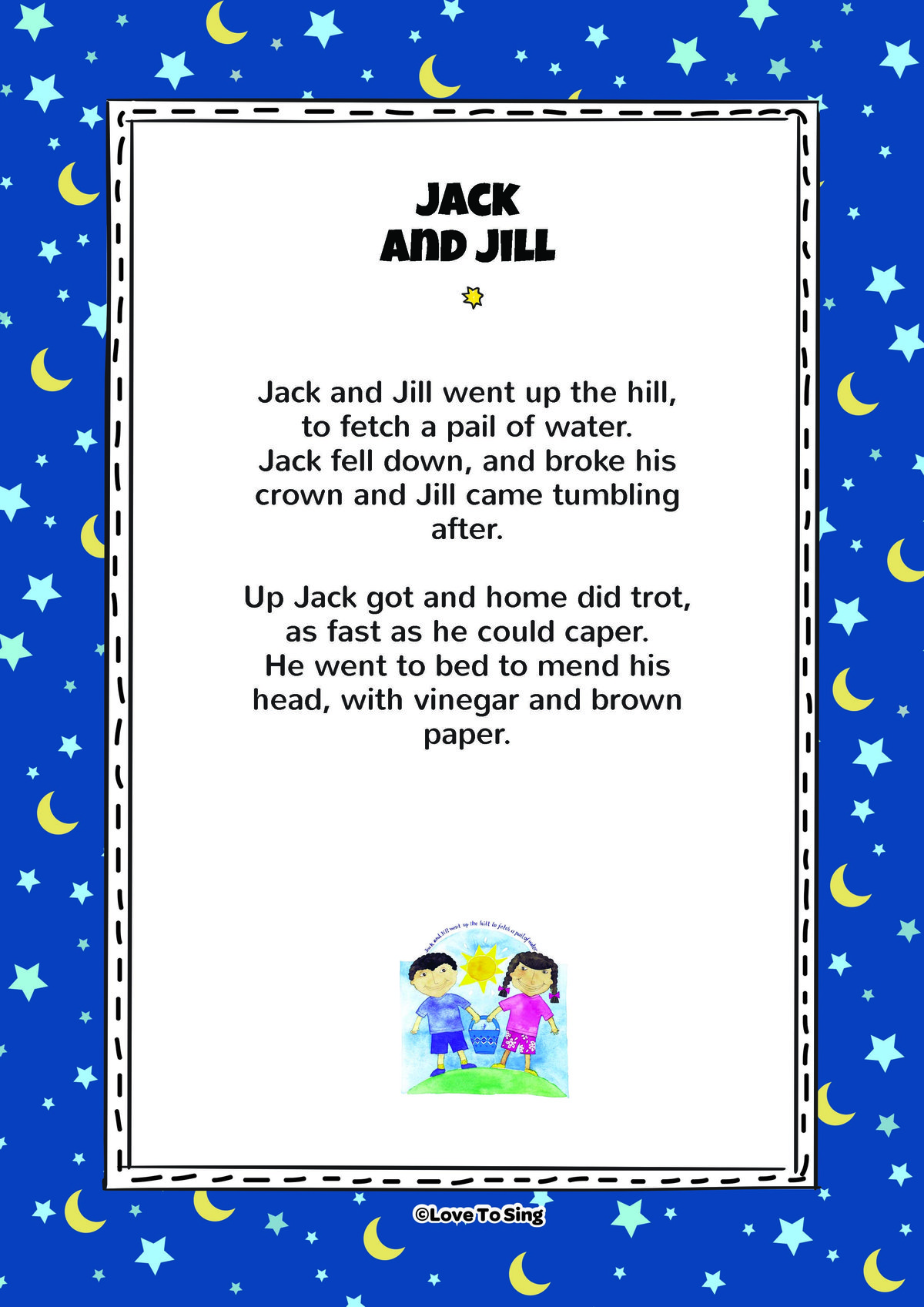
Here are the full traditional lyrics of the "Jack and Jill" nursery rhyme:
Jack and Jill went up the hill
To fetch a pail of water.
Jack fell down and broke his crown,
And Jill came tumbling after.
Up Jack got, and home did trot,
As fast as he could caper,
To old Dame Dob, who patched his nob
With vinegar and brown paper.
Notice the slightly different, perhaps more vivid, language in those latter verses. "Broke his crown" and "patched his nob" are phrases that give us a clue to the rhyme's age and its charmingly direct approach to childhood scrapes.
A Quick Detour: The Modern Twist
Before we dive into the murky waters of history, it's worth noting how the rhyme often appears today. Many modern versions omit the "Dame Dob" segment, sometimes replacing it with a more emotionally supportive ending. This highlights how cultural stories adapt over time, reflecting changing sensitivities or simply a desire for a tidier narrative.
A common modern variation you might hear goes like this:
Jack and Jill went up the hill
To fetch a pail of water.
Jack fell down and broke his crown,
And Jill came tumbling after.
Then up got Jack and said to Jill,
As in his arms he took her,
“Brush off that dirt for you’re not hurt,
Let’s fetch that pail of water.”
So Jack and Jill went up the hill
To fetch the pail of water,
And took it home to Mother dear,
Who thanked her son and daughter.
This version offers a comforting, resilient ending, emphasizing teamwork and parental gratitude over a vinegar compress. It's a testament to the rhyme's flexibility and its enduring role in shaping moral lessons for young listeners.
Tracing the Footprints: When Did Jack and Jill First Appear?
While the rhyme feels timeless, its documented history begins in 18th-century England. The first known recorded version of "Jack and Jill" appeared around 1765, cementing its place in popular culture. However, its wider fame truly blossomed when it was published in Mother Goose’s Melody as a song by John Newbery. This collection, which began appearing in the late 1700s, played a pivotal role in popularizing many of the nursery rhymes we know today.
Interestingly, early versions weren't always "Jack and Jill." Initially, the rhyme was sometimes known as "Jack and Gill," possibly referring to two boys. It seems the "Jill" we know came along later, perhaps as the rhyme evolved to fit common gender pairings. This slight shift, though seemingly minor, hints at a broader linguistic history.
Jack and Jill: More Than Just Names
Before they were literary characters, "Jack" and "Jill" (or "Gill") were simply common generic terms for a boy and a girl. Think of them like "everyman" and "everywoman" of their time. This isn't just speculation; these terms appeared frequently in English literature centuries before the rhyme became popular.
For example, William Shakespeare, the master wordsmith himself, used "Jack" and "Jill" in his plays to refer to generic young men and women. In A Midsummer Night’s Dream, Puck famously declares, "Jack shall have Jill; Nought shall go ill; And all shall be well." This isn't a direct quote from our nursery rhyme, but it beautifully illustrates the long-standing use of these names as archetypes for young lovers or companions. The very universality of the names helped the rhyme resonate, making its characters instantly relatable to audiences for generations. To truly delve deeper into Jack and Jill's world, we must appreciate this linguistic bedrock.
The Hill of Theories: Unpacking the "Why" Behind the Fall
Here’s where the "Jack and Jill" story gets really intriguing. While many nursery rhymes have simple, straightforward origins—often as teaching tools or playful nonsense—"Jack and Jill" has inspired a remarkable range of interpretations. Some are whimsical, others symbolic, and a few even tie the rhyme to dramatic historical events. It's crucial to remember that while these theories are compelling, no single explanation is universally accepted as definitive proof. They are, however, excellent lenses through which to appreciate the rhyme's enduring mystery.
Let’s explore the most prominent theories:
1. The Lunar Saga: An Allegory of the Moon
Perhaps the most poetic and ancient interpretation links "Jack and Jill" to the celestial dance of the Moon. This theory proposes that the rhyme is an allegory for the Moon's phases and its influence on the tides.
- "Going up the hill": This is seen as symbolic of the rising tide when the Moon waxes—growing fuller and pulling the water higher.
- "Falling down": Represents the subsequent ebb, as the tide recedes and the Moon wanes.
This idea isn't entirely new or unique to English folklore. Proponents of this theory often point to a 13th-century Norse mythology tale recounted by Snorri Sturluson. In this ancient story, a boy named Hjúki (whose name bears a phonetic resemblance to "Jack") and a girl named Bil (sometimes interpreted as an early form of "Jill") are taken up to the Moon while they are collecting water. They carry a pail, much like Jack and Jill.
Further linguistic comparisons suggest that the names Hjúki and Gil (an alternative Old Norse name for Bil) may relate to old Scandinavian verbs. "Hjúki" might derive from a word meaning "to heap" or "to gather," while "Gil" could come from a word meaning "to reduce" or "to abate." These meanings mirror the Moon's waxing (heaping) and waning (reducing), providing a fascinating etymological layer to the lunar theory. It’s a compelling thought that a simple children's rhyme might echo ancient cosmic observations.
2. A Pint-Sized Political Protest: The Tax Reform Theory
Moving from cosmic movements to parliamentary maneuvering, another popular theory places "Jack and Jill" firmly in the realm of 17th-century English political satire. This interpretation connects the rhyme to a specific tax dispute under King Charles I.
The story goes that King Charles I, seeking to raise revenue, proposed increasing alcohol taxes. When Parliament opposed his plan, he reportedly found a loophole. Instead of raising the tax amount, he simply reduced the standard volume of the "jack" (a measure equivalent to half a pint) and the "gill" (a measure equivalent to a quarter pint). The tax rate remained the same, but because the measures were smaller, consumers were effectively paying the same amount for less product.
In this context:
- "Jack fell down and broke his crown": Could symbolize the King ("crown") facing opposition and being "broken" by the dispute, or perhaps the common man's "crown" (head) being hurt by the unfair change. It also refers to the "jack" measure being reduced.
- "And Jill came tumbling after": The "gill" measure suffering the same fate, shrinking in volume right after the "jack."
If true, this theory transforms a seemingly innocent nursery rhyme into a clever piece of political commentary, a subtle protest against royal manipulation of common measures. It speaks to a time when folklore and song were often used to disseminate news and express public sentiment, especially when direct criticism could be dangerous. To grasp the full implications of this, it helps to uncover more about Jack and Jill's historical context.
3. A Royal Downfall: The French Revolution Theory
Perhaps the most dramatic and historically charged theory connects "Jack and Jill" to the bloody events of the French Revolution. This interpretation suggests that the rhyme is a veiled account of the execution of King Louis XVI and his queen, Marie Antoinette.
- "Jack fell down and broke his crown": This is seen as a direct reference to King Louis XVI, who was stripped of his royal "crown" (monarchy) and then executed by guillotine in January 1793. The "crown" could refer to his head, literally broken by the falling blade.
- "And Jill came tumbling after": This would represent Queen Marie Antoinette, who followed her husband to the guillotine just nine months later, in October 1793. Her "tumbling" mirrors the king's fate.
The timing of this theory is particularly compelling for some. The rhyme began to appear in print shortly after these executions, leading proponents to believe it was a subversive way to comment on the shocking regicide across the Channel. While there's no definitive proof linking the rhyme directly to these events, the parallel is certainly striking and adds a dark, poignant layer to the seemingly simple tale. For those interested in this dramatic reading, exploring the rhyme's appearance in various historical publications can reveal more about Jack and Jill's controversial interpretations.
4. Shakespeare's Playful Nod: The Literary Connection
While not a full-blown theory of origin, the connection to Shakespeare highlights the rhyme's deep roots in English language and culture. As mentioned earlier, Puck's lines in A Midsummer Night’s Dream — "Jack shall have Jill; Nought shall go ill; And all shall be well" — show that the pairing of "Jack and Jill" as generic or symbolic figures was already well-established by the late 16th century.
Shakespeare's use of the names also often plays with lunar symbolism, especially within A Midsummer Night’s Dream, which itself is steeped in moonlit enchantment. This subtle link might lend indirect support to the lunar allegory theory, suggesting that the association of Jack, Jill, and the Moon has a much longer, albeit perhaps unconscious, tradition in English storytelling. It reinforces the idea that these characters are part of a larger, evolving narrative tapestry.
Breaking Down the Descent: What Each Line Truly Means
Let's return to the rhyme itself and break down its traditional meaning, line by line, before considering how our theories add layers of complexity.
"Jack and Jill went up the hill"
This sets the scene. A "hill" is a common obstacle in folk tales, suggesting effort or a journey. It’s a relatable, everyday task. No hidden meaning here, just a simple description of the journey.
"To fetch a pail of water"
The purpose of their ascent. Water was, and remains, a fundamental necessity. In earlier times, drawing water often involved a trip to a well, spring, or communal pump, which might be located on higher ground, requiring a trip "up the hill." This establishes a practical, domestic context for their adventure.
"Jack fell down and broke his crown"
This is the pivotal moment. "Broke his crown" is the phrase that sparks the most debate. Literally, it means Jack hit his head. "Crown" was a colloquial term for the top of the head in Old English, and the verb "broke" suggests a hard blow, perhaps even a gash. Figuratively, it could suggest a loss of dignity or status.
- Lunar Theory: The Moon's peak (crown) reaching its zenith before its descent.
- Tax Theory: King Charles I's authority (crown) challenged or the "jack" measure being "broken" (reduced).
- French Revolution Theory: King Louis XVI's head (crown) literally broken by the guillotine.
"And Jill came tumbling after"
Jill's fall immediately follows Jack's. This emphasizes their close companionship and shared misfortune. She might have been startled, lost her footing, or simply followed him down in a cascade of clumsy events. - Lunar Theory: The tide's ebb following the Moon's wane.
- Tax Theory: The "gill" measure following the "jack" in reduction.
- French Revolution Theory: Queen Marie Antoinette's execution following King Louis XVI's.
"Up Jack got, and home did trot, / As fast as he could caper,"
Despite his injury, Jack is resilient. He picks himself up quickly ("trot," "caper" suggest speed and urgency, perhaps even a touch of panic). This part of the rhyme gives a sense of immediacy and the fear of a child who has hurt himself.
"To old Dame Dob, who patched his nob / With vinegar and brown paper."
This is the resolution, and it's quite specific. "Nob" is another old term for the head. "Dame Dob" is a generic term for an old woman, likely a local healer or a wise grandmother figure. The remedy—vinegar and brown paper—was a common folk cure for bumps and bruises. Vinegar was thought to have antiseptic and pain-relieving properties, while brown paper might have been used as a makeshift bandage or compress. This section grounds the rhyme in the domestic realities of its time, showing a practical, if quaint, approach to first aid. It also reassures the listener that Jack ultimately recovered. This entire final segment often gets lost in modern tellings, yet it provides such a vivid snapshot of historical practices, something you can discover more Jack and Jill lore in older texts.
Beyond the Tumble: The Enduring Power of Nursery Rhymes
"Jack and Jill," like many nursery rhymes, performs multiple cultural functions. On the surface, it's a simple story, easy for children to remember, and often accompanied by playful actions. But beneath that, it teaches several subtle lessons:
- Cause and Effect: Actions (going up a hill with water) have consequences (falling).
- Resilience: Jack gets up and goes home, seeking help.
- Vocabulary and Rhythm: Rhymes aid in language development and memory.
- Cultural Transmission: They carry snippets of history, language, and social norms from one generation to the next.
Even if we never definitively prove which historical event or cosmic phenomenon inspired "Jack and Jill," its longevity speaks volumes. Its simple narrative, coupled with the intriguing possibilities of deeper meaning, has ensured its place in the literary canon. It's a testament to the power of succinct storytelling that a few lines can spark centuries of debate and delight.
Common Questions About Jack and Jill
Given its multifaceted history, it's natural to have questions about Jack and Jill. Here are some of the most frequently asked:
Q: Who were Jack and Jill?
A: In the context of the nursery rhyme, Jack and Jill are generic characters, common terms for a boy and a girl in 16th-century England and beyond. They are archetypal figures, not necessarily specific historical individuals, though some theories attempt to link them to real people or entities.
Q: What does "broke his crown" mean?
A: "Broke his crown" colloquially means Jack injured the top of his head. "Crown" was a term for the skull or the top of the head. In some historical interpretations, it's also linked symbolically to a king's crown (monarchy) or the "jack" measure itself.
Q: Is Jack and Jill a true story?
A: There is no single, universally accepted "true story" behind the Jack and Jill nursery rhyme. While theories link it to historical events like King Charles I's tax reforms or the French Revolution, these are interpretations rather than proven facts. The most reliable origin points to it being a popular rhyme from 18th-century England, likely evolving from older linguistic uses of "Jack" and "Jill" as generic terms.
Q: Why did they go up the hill?
A: Jack and Jill went up the hill "to fetch a pail of water." In earlier times, sources of fresh water (wells, springs) were often located outside of villages or on higher ground, requiring a journey. It was a common, necessary chore.
Q: Is there a happy ending to Jack and Jill?
A: In the full traditional version, Jack gets his head patched up by Dame Dob, suggesting a resolution where he recovers, though perhaps with a sore head. Many modern versions rewrite the ending to be explicitly positive, with Jack and Jill going back for the water and delivering it to their mother, ensuring a "happily ever after" for the chore.
Why Jack and Jill Still Captivates Us
From the moonlit skies of Norse mythology to the political machinations of 17th-century England and the grim realities of the French Revolution, "The Jack and Jill Nursery Rhyme: Full Lyrics and Story" offers a surprising journey through history and folklore. It reminds us that even the simplest stories can carry layers of meaning, transforming from innocent verses into cryptic historical commentaries or ancient cosmic tales.
The enduring mystery is part of its charm. We love to search for hidden meanings, to connect familiar childhood rhymes to grander narratives. Whether you prefer the gentle ebb and flow of lunar tides, the subtle protest against unfair taxes, or the stark imagery of a royal downfall, Jack and Jill continue to inspire wonder and speculation. They are more than just two children with a pail; they are timeless figures, forever tumbling through our collective imagination, prompting us to ask: What truly happened on that hill? And what other secrets might our beloved nursery rhymes hold? To explore the full story of Jack and Jill, and other captivating tales, continue your journey into the world of folklore and history. Dive into Jack Plus Jill to uncover even more!